
Tint Law Chart Canada
 Canada Window Tint Laws:
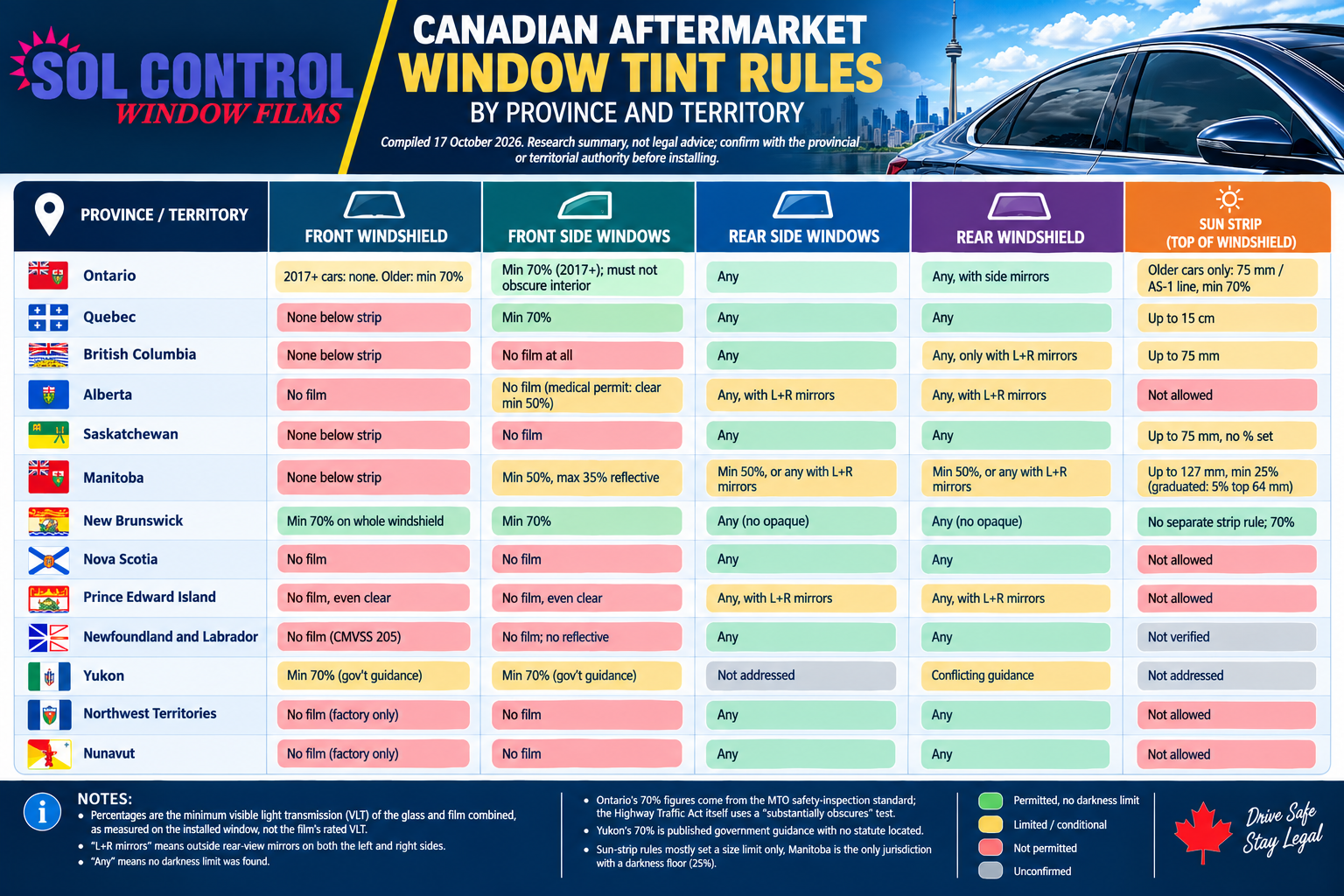
Ontario
Legal basis: Highway Traffic Act ss.73–74; R.R.O. 1990, Reg. 611 (Safety Inspections), which incorporates the MTO Passenger/Light-Duty Vehicle Inspection Standard. Verified via: legal summary (Recording Law, Ontario); e-Laws could not be loaded by the research tool. Enforcement test: qualitative at roadside; numeric at safety inspection.
|
Window |
Status |
Rule |
|
Front windshield |
Conditional |
Vehicles made 1 Jan 2017 or later fail inspection with any aftermarket tint. Older vehicles: ≥70% and within 75 mm of the top or the AS line. |
|
Front side windows |
Conditional |
HTA s.73(3) bans coloured or reflective material that substantially obscures the interior from outside. The inspection standard requires ≥70% on 2017+ vehicles. No numeric floor verified for pre-2017 vehicles. |
|
Rear side windows |
Confirmed permitted |
No darkness limit found in the Act or the inspection standard. |
|
Rear windshield |
Conditional |
s.74(2) removes the rear clear-view duty when mirrors give an equivalent rear view. No darkness limit. |
Conflict to note: police releases (e.g. Sault Ste. Marie, 2022) describe a 70% front-side rule "under the HTA", but the Act's text contains no percentage. Treat 70% as the safe target for all vehicles.
Quebec
Legal basis: Highway Safety Code s.265; Regulation respecting safety standards for road vehicles (C-24.2, r.32), ss.63–64. Verified via: SAAQ "Voir clair" brochure (official) and the 1999 Gazette amendment. Enforcement test: photometer reading of the front side windows.
|
Window |
Status |
Rule |
|
Front windshield |
Restricted |
No darkening material, except a band up to 15 cm wide at the top. |
|
Front side windows |
Conditional |
Must transmit ≥70% light measured by photometer. |
|
Rear side windows |
Confirmed permitted |
Not subject to the tint rule (SAAQ). |
|
Rear windshield |
Confirmed permitted |
Not subject to the tint rule (SAAQ). Mirror requirement: no explicit tint-linked rule verified. |
SAAQ warns that factory front glass often transmits about 75%, so even a clear film can drop it to the limit.
British Columbia
Legal basis: Motor Vehicle Act Regulations, s.7.05(8). Verified via: RCMP BC Traffic Services FAQ and ICBC inspection guidance (official). Enforcement test: presence of any material that reduces light.
|
Window |
Status |
Rule |
|
Front windshield |
Restricted |
Material allowed only within 75 mm of the top. |
|
Front side windows |
Not permitted |
No tint of any kind, including light tint (RCMP). |
|
Rear side windows |
Confirmed permitted |
Any side window behind the driver; no VLT limit. |
|
Rear windshield |
Conditional |
Only if the vehicle has outside mirrors on both left and right. |
Alberta
Legal basis: Vehicle Equipment Regulation, Alta Reg 122/2009, s.70; Traffic Safety Act ss.65–66. Verified via: legal summary (Recording Law, Alberta) and the Alberta.ca tint exemption page it cites. Enforcement test: installing or covering front glass with any transparent, translucent or opaque material.
|
Window |
Status |
Rule |
|
Front windshield |
Not permitted |
Same flat ban as front sides. No top-strip allowance; only clear frost shields and non-obstructing stickers. |
|
Front side windows |
Not permitted |
Flat ban. Medical permit holders may install clear UV film ≥50% VLT. |
|
Rear side windows |
Conditional |
Allowed with outside mirrors on both sides. No VLT limit. |
|
Rear windshield |
Conditional |
Same mirror condition. No VLT limit. |
Material must not reflect headlamps or sunlight into other drivers' eyes (functional test, no percentage).
Saskatchewan
Legal basis: Vehicle Equipment Regulations, 1987, ss.64, 66–67. Verified via: SGI spokesperson statement (news) and legal summary (Recording Law, Saskatchewan). Enforcement test: presence of non-factory sunscreen or reflective coating.
|
Window |
Status |
Rule |
|
Front windshield |
Restricted |
Sunscreen strip up to 75 mm from the top (added 2021). No % set for the strip. Whether a reflective strip qualifies is unconfirmed. |
|
Front side windows |
Not permitted |
No sunscreen or reflective coating other than the glass manufacturer's. |
|
Rear side windows |
Confirmed permitted |
No darkness limit; no tint-linked mirror condition. |
|
Rear windshield |
Confirmed permitted |
No darkness limit; two mirrors are required on all vehicles regardless. |
Manitoba
Legal basis: Vehicle Equipment, Safety and Inspection Regulation, Man Reg 31/2019, s.3.22; Vehicle Inspection Handbook (Schedule E). Verified via: Manitoba Public Insurance statement (via Morden Police, news) and legal summary (Recording Law, Manitoba). Enforcement test: tint meter; a reading ≥95% of the minimum passes (so 47.5% passes a 50% rule).
|
Window |
Status |
Rule |
|
Front windshield |
Restricted |
Top 127 mm only: uniform band ≥25%, or graduated band 5% in top 64 mm and ≥25% from 64–127 mm. Factory CMVSS tint exempt. |
|
Front side windows |
Conditional |
≥50% light transmission and ≤35% reflectance. Inspection handbook separately rejects any reflective film (conflict). |
|
Rear side windows |
Conditional |
≥50%, unless outside mirrors on both sides, then no limit. |
|
Rear windshield |
Conditional |
Same as rear sides; film must not cover the centre high-mounted stop lamp. |
New Brunswick
Legal basis: Motor Vehicle Act, RSNB 1973, c.M-17, s.238(1)–(1.4). Verified via: legal summary (Recording Law, New Brunswick). Enforcement test: photometer (no more than 30% of light blocked) plus a separate qualitative no-obstruction test.
|
Window |
Status |
Rule |
|
Front windshield |
Conditional |
≥70% across the entire windshield (no strip-only limit). Must also not obstruct the driver's view or obscure the interior. |
|
Front side windows |
Conditional |
≥70%, plus the same no-obstruction test. |
|
Rear side windows |
Confirmed permitted |
Outside the 30% cap. Opaque material is still banned (s.238(1)). |
|
Rear windshield |
Confirmed permitted |
Same as rear sides. Tint-linked mirror rule: not verified. |
Factory glazing and equivalent replacements are exempt (s.238(1.2)).
Nova Scotia
Legal basis: Standards of Vehicle Equipment Regulations, NS Reg 51/85, s.3(2)–(5), under the Motor Vehicle Act. Verified via: RCMP Nova Scotia release, May 2022 (official) and legal summary (Recording Law, Nova Scotia). Enforcement test: any substance that reduces light on front glass.
|
Window |
Status |
Rule |
|
Front windshield |
Not permitted |
No tint on any part; no top-strip allowance. Factory-tinted glass and clear frost shields exempt. |
|
Front side windows |
Not permitted |
No tint of any kind (RCMP). |
|
Rear side windows |
Confirmed permitted |
May be tinted by any amount (RCMP). |
|
Rear windshield |
Confirmed permitted |
May be tinted by any amount (RCMP). |
A new Traffic Safety Act passed in October 2025 but was not in force at last check; the current rule applies until proclaimed.
Prince Edward Island
Legal basis: Highway Traffic Act, RSPEI 1988, c.H-5, s.138 and s.214(a). Verified via: legal summary (Recording Law, PEI). Enforcement test: presence of any added material on front glass.
|
Window |
Status |
Rule |
|
Front windshield |
Not permitted |
No transparent, translucent or opaque material. Exceptions: factory-equivalent glass, clear frost shields, non-obstructing stickers. |
|
Front side windows |
Not permitted |
Same; the word "transparent" means even clear film is caught on a literal reading. |
|
Rear side windows |
Conditional |
Any darkness if outside mirrors on both sides (s.138(2)). |
|
Rear windshield |
Conditional |
Same mirror condition. |
Glare-producing material is separately banned (s.138(5)).
Newfoundland and Labrador
Legal basis: Licensing and Equipment Regulations, CNLR 1007/96, s.38, under the Highway Traffic Act. Verified via: RCMP NL release, March 2026 (official) and legal summary (Recording Law, NL). Enforcement test: whether the glazing still conforms to federal CMVSS 205.
|
Window |
Status |
Rule |
|
Front windshield |
Not permitted |
No material that makes the glazing non-conforming with CMVSS 205. RCMP: tint not permitted. No explicit provincial VLT limit verified. |
|
Front side windows |
Not permitted |
Same rule; RCMP also states reflective tint is prohibited. |
|
Rear side windows |
Confirmed permitted |
Outside s.38. |
|
Rear windshield |
Confirmed permitted |
Outside s.38. Tint-linked mirror rule: not verified. |
Yukon
Legal basis: No statute or regulation setting a tint percentage was located. The Government of Yukon tint page (May 2026) states the standard; Motor Vehicles Act s.190 (obscured windshield) is the likely enforcement hook. Verified via: official page opened. Enforcement test: tint meter at the Motor Vehicles office; roadside notice to remove.
|
Window |
Status |
Rule |
|
Front windshield |
Conditional |
≥70% (government guidance). |
|
Front side windows |
Conditional |
≥70% on driver and front passenger windows (government guidance). |
|
Rear side windows |
Unconfirmed |
Not addressed by the government page. |
|
Rear windshield |
Unconfirmed |
Not on the government page; an earlier Yukon RCMP statement included the rear window in the 70% rule. |
Northwest Territories
Legal basis: Motor Vehicle Equipment Regulations, RRNWT 1990, c.12 (Supp.), s.58. Verified via: legal summary (Recording Law, territories). Enforcement test: presence of non-factory sunscreen or reflective coating.
|
Window |
Status |
Rule |
|
Front windshield |
Not permitted |
Must be free of sunscreen or reflective coating other than the manufacturer's. |
|
Front side windows |
Not permitted |
The text says "front passenger side windows"; read as both front windows, but the wording is ambiguous. |
|
Rear side windows |
Confirmed permitted |
Outside s.58. |
|
Rear windshield |
Confirmed permitted |
Outside s.58. |
Nunavut
Legal basis: Motor Vehicle Equipment Regulations (Nunavut consolidation), s.58, inherited from NWT. Verified via: legal summary (Recording Law, territories). The government consolidation is marked current only to 30 December 2018.
|
Window |
Status |
Rule |
|
Front windshield |
Not permitted |
Same wording as NWT s.58. |
|
Front side windows |
Not permitted |
Same ambiguity as NWT. |
|
Rear side windows |
Confirmed permitted |
Outside s.58. |
|
Rear windshield |
Confirmed permitted |
Outside s.58. |
VLT explained
Visible light transmission (VLT) is the percentage of visible light that passes through the glass. Higher VLT means lighter glass; lower VLT means darker glass. Every numeric Canadian rule found in this research is a minimum VLT floor, measured on the window as installed.
|
Film VLT |
Typical look |
Common use |
|
5% |
Very dark ("limo") |
Rear privacy glass |
|
15% |
Very dark |
Rear windows |
|
20% |
Dark |
Rear windows |
|
35% |
Medium-dark |
Rear windows; some US-style front installs |
|
50% |
Lighter |
Manitoba front sides (if combined reading stays at 50%+) |
|
70% |
Light |
Quebec / Ontario-style front side thresholds |
|
80–90% |
Near clear |
Clear ceramic / UV-IR films |
Film VLT is not window VLT. Enforcement measures the glass plus the film together. Combined VLT is roughly the product of the two:
Example: factory front side glass at about 75% VLT plus an 80% "clear" film gives about 60% combined. That passes a 50% rule (Manitoba) but fails a 70% rule (Quebec, Ontario). Quebec's SAAQ warns that factory front glass often already transmits only about 75%, so even a clear film can push it to the 70% line.
Do not confuse VLT with other specs. UV rejection, infrared (IR) rejection, total solar energy rejected (TSER) and reflectivity are separate measurements. A film can reject 99% of UV and still have a VLT of 70%. Reflectivity is regulated separately in some provinces (for example, Manitoba caps front-side reflectance at 35%).
Clear ceramic, UV/IR and windshield protection films
High VLT alone does not make a film legal. No jurisdiction reviewed has a general exemption for clear or "colourless" film; legality depends on how each rule is worded.
|
How the rule is worded |
Jurisdictions |
Clear 70–90% film on front glass |
|
Bans any material, including transparent |
Alberta, PEI |
Not permitted (Alberta: except medical permit, clear UV ≥50%) |
|
Bans any material that reduces light |
BC, Nova Scotia |
Not permitted if it reduces transmission at all; almost every film does |
|
Bans non-factory sunscreen or reflective coating |
Saskatchewan, NWT, Nunavut |
Unconfirmed whether a clear UV/IR film counts as "sunscreen"; treat as not permitted |
|
Requires continued CMVSS 205 conformance |
Newfoundland and Labrador |
Unconfirmed; depends on the federal standard, which this review did not open |
|
Sets a numeric floor |
Quebec, NB (70%), Ontario 2017+ front sides (70%), Manitoba (50%), Yukon (70%) |
Conditional: the combined glass + film reading must meet the floor |
|
Windshield ban by vehicle date |
Ontario 2017+ vehicles |
Not permitted on the windshield, however clear |
Practical points for clear films
- A "70% film" on factory glass at 75–80% usually reads about 52–56% combined. That fails every 70% floor and passes only Manitoba's 50%.
- To pass a 70% rule, the film needs roughly 88% VLT on 80% glass, or 93% on 75% glass. Meter the actual vehicle; do not rely on the spec sheet.
- Spectrally selective (IR-rejecting) films often have high VLT but can have elevated reflectance. Manitoba caps front reflectance at 35%; Alberta, PEI and NL ban glare-producing or reflective material by function.
- Windshield "protection" films (impact or chip films) are still material on the windshield. They are caught by the bans in AB, NS, PEI, BC (below 75 mm), SK (below 75 mm), QC (below 15 cm) and Ontario 2017+ vehicles. No jurisdiction was found to exempt them.
- No official optical-clarity or installation standard for aftermarket windshield film was found in any jurisdiction.
Enforcement, fines, inspections and exemptions
Every jurisdiction lets police ticket illegal front tint; several also let officers order removal or take the vehicle off the road. Dollar figures below are only those traced to an official source or a legal summary of one.
|
Jurisdiction |
Fine |
Other enforcement |
Medical exemption |
|
Ontario |
$85 set fine (Schedule 43); $60–$1,000 at trial (HTA s.214) |
Fails Safety Standards Certificate; some police rescind tickets if tint is removed within 72 h |
None found |
|
Quebec |
$100–$200 (passenger vehicle, per SAAQ) |
Notice to have windows verified by an SAAQ agent; changes required within 48 h |
None found |
|
British Columbia |
$109 violation ticket |
"Box 2" Notice and Order to remove; ICBC may refuse a road test |
Unconfirmed |
|
Alberta |
$88 specified penalty, plus surcharge |
Officer may order repair or removal from operation; plates and registration can be seized (TSA s.66) |
Yes. Registrar permit, $55, physician letter, closed list of conditions; clear UV film ≥50% VLT |
|
Saskatchewan |
$75 (<11,000 kg) or $100; up to $1,000 if contested |
Officer may order vehicle off the road until fixed |
None found |
|
Manitoba |
About $174 first, $298 second, $672 third (within 5 years) |
Fails periodic inspection; stations must own a calibrated tint meter; compliance mark via Tinting Inspection Report |
None found |
|
New Brunswick |
Unconfirmed ($172.50 circulates) |
— |
None found |
|
Nova Scotia |
From $180 (RCMP, 2022) |
— |
None found |
|
PEI |
Unconfirmed |
— |
None found |
|
Newfoundland and Labrador |
Unconfirmed (minimum raised to $100 in 2018 for illegal modifications; tint not confirmed in that category) |
No demerit points |
None found |
|
Yukon |
Unconfirmed |
Notice to remove by a date; then ticket and removal from road (RCMP) |
None found |
|
NWT / Nunavut |
Unconfirmed ticket amount; general maximum $5,000 or 6 months |
— |
None found |
Other enforcement questions
- Out-of-province vehicles: no visitor exemption was found in any jurisdiction. Rules apply to vehicles operated on that jurisdiction's roads. Unconfirmed how strictly this is enforced against visitors.
- Certification or labels: only Manitoba was found to provide a formal compliance mark. No jurisdiction was found to require installer labels.
- Police, emergency and other special vehicles: no tint-specific exemptions were verified in the sources reviewed.
Legal references
All accessed 17 October 2026. "Opened" means the page itself was read in this review; "excerpt" means the official text was read in a search-result excerpt; "cited" means the primary law was relied on through a legal summary that quotes it.
|
Jurisdiction |
Source |
Access |
What it establishes |
|
Ontario |
Cited |
Qualitative obscuring test; rear clear-view mirror carve-out |
|
|
Ontario |
Cited |
70% figures and 2017 manufacture-date split |
|
|
Ontario |
Cited |
$85 set fine |
|
|
Quebec |
Excerpt |
70% front sides, 15 cm windshield band, rear not regulated, fines |
|
|
Quebec |
Excerpt |
Origin of the 70% and 15 cm rules |
|
|
British Columbia |
Excerpt |
Window-by-window rules; $109 ticket; Notice and Order |
|
|
British Columbia |
Excerpt |
MVA Regulations s.7.05(8) summary |
|
|
Alberta |
Cited |
s.70 front ban; rear mirror condition |
|
|
Alberta |
Cited |
Medical permit process |
|
|
Saskatchewan |
Cited |
ss.64, 66 bans; 75 mm strip |
|
|
Saskatchewan |
Cited |
Plain-language confirmation of front ban |
|
|
Manitoba |
Cited |
50% / 35% front; 127 mm strip; rear mirror rule |
|
|
Manitoba |
Cited |
Fine amounts |
|
|
New Brunswick |
Cited |
30% blocked cap on windshield and front sides |
|
|
Nova Scotia |
Cited |
Absolute front ban |
|
|
Nova Scotia |
Excerpt |
No front tint; rear any amount; fine from $180 |
|
|
PEI |
Cited |
Ban on transparent, translucent or opaque material |
|
|
Newfoundland and Labrador |
Cited |
CMVSS 205 conformance rule |
|
|
Newfoundland and Labrador |
Excerpt |
No tint on windshield or front sides; reflective prohibited |
|
|
Yukon |
Opened |
70% on windshield and front side windows |
|
|
Northwest Territories |
Cited |
Front sunscreen/reflective coating ban |
|
|
Nunavut |
Cited |
Same as NWT s.58 |
Legal summaries opened: Recording Law provincial guides for Ontario, Alberta, Saskatchewan, Manitoba, New Brunswick, Nova Scotia, PEI, NL and the territories, each fact-checked by its publisher on 16 August 2026 but not reviewed by a lawyer.
Unresolved questions
These points could not be settled from the sources reviewed. The first three matter most for an Ontario-based wholesaler.
- Ontario roadside percentage. Is 70% enforceable roadside, or only at Safety Standards Certificate inspections? Police releases say 70% "under the HTA"; the Act's text has no percentage. Confirm with MTO.
- Ontario pre-2017 front sides. No numeric floor was verified for vehicles made before 1 January 2017; only the qualitative s.73(3) test.
- Ontario e-Laws text. The current consolidation could not be loaded directly; s.73 and s.74 wording rests on a legal summary. Re-check on e-Laws.
- Clear film in sunscreen-ban jurisdictions. Do Saskatchewan, NWT and Nunavut treat a clear UV/IR film as "sunscreen"? No guidance found.
- PEI "transparent" wording. Does enforcement actually reach truly clear film? No guidance or case law found.
- Newfoundland and Labrador VLT. The CMVSS 205 percentage was not verified against the federal standard.
- Manitoba reflectance conflict. The regulation allows ≤35% reflectance; the inspection handbook rejects any reflective film.
- Yukon legal basis and rear glass. No statute sets 70%; rear-window guidance conflicts between the government page and an older RCMP statement.
- NWT and Nunavut wording. "Front passenger side windows" may or may not include the driver's window. Nunavut's consolidation is marked out of date (2018).
- Mirror conditions in Quebec, New Brunswick, Nova Scotia and NL for rear-windshield tint: not verified either way.
- Fines in NB, PEI, NL, Yukon, NWT and Nunavut: no confirmed ticket amount.
- BC medical exemption: sources conflict; not confirmed.
- Pending law changes: Nova Scotia's Traffic Safety Act (passed October 2025) and Yukon's draft Traffic Safety Act (Bill 044) could change these rules.
Practical guide for installers, wholesalers and retailers
For front side windows, the safe answer in most of Canada is no film; rear glass is open almost everywhere if both outside mirrors are present.
Common film options on front side windows (assumes factory glass at 75–80% VLT; combined reading ≈ glass × film)
|
Film VLT |
Combined ≈ |
BC, AB, SK, NS, PEI, NWT, NU |
QC, NB, Yukon, Ontario 2017+ (70%) |
Manitoba (50%) |
NL |
|
5% |
4% |
Not permitted |
Not permitted |
Not permitted |
Not permitted |
|
15% |
11–12% |
Not permitted |
Not permitted |
Not permitted |
Not permitted |
|
20% |
15–16% |
Not permitted |
Not permitted |
Not permitted |
Not permitted |
|
35% |
26–28% |
Not permitted |
Not permitted |
Not permitted |
Not permitted |
|
50% |
38–40% |
Not permitted |
Not permitted |
Not permitted |
Not permitted |
|
70% |
53–56% |
Not permitted |
Not permitted |
Conditional (meter it) |
Unconfirmed |
|
85–90% clear |
64–72% |
Not permitted |
Conditional (meter it; often fails) |
Conditional |
Unconfirmed |
Rear side and rear windows: 5% to 70% films are permitted in every province, subject to the mirror conditions in BC (rear windshield), Alberta, Manitoba, PEI and Ontario. Yukon rear glass is unconfirmed. Keep the third brake light clear.
Shop checklist
- Meter the front glass before and after install; record both readings on the work order.
- Confirm the customer's province of registration and where they mainly drive.
- Confirm left and right outside mirrors before tinting the rear windshield.
- For Ontario, check the vehicle's manufacture date: 2017+ means no windshield film and ≥70% front sides.
- Do not sell windshield or front-side film as "legal" in AB, BC, SK, NS, PEI, NWT or Nunavut, even if clear.
- Have customers sign a disclosure when they request film that does not meet the local rule.
- Alberta customers with a medical permit: install only clear UV film ≥50%, and keep a copy of the permit.